Showing posts with label G321 Thriller research. Show all posts

Thursday, 5 January 2017

Thriller Title Sequences - UPDATED


Font is often used within a film to show certain aspects such as genre or tone. 


The opening sequence of Se7en (1995), presents typeface which suggests danger, the flickering and movement of the font perhaps representing an instability in the killers mind. The font used- sans serif- is a simplistic style, and perhaps foreshadows the killers mind, and their sociopathic lack of emotion or sympathy. This is enforced by the colour of the font, which is white throughout the title sequence, also showing an idea of simplicity which could mean a possible threat. 


The typeface used for names mimics a handwriting style, making it seem more personal. Hands appear to be an important part of the film, and feature in the opening titles, perhaps linking to this style of font. Furthermore, the font continues to flicker, further enforcing the idea of instability of a murderers mind. The placement of each name or title seems unorganised and at random on the screen, perhaps further suggesting instability, the unmethodical and erratic style used to strike fear within the audience.


Another film which uses font effectively is Zodiac (2007). When the film opens the audience are immediately introduced to a newspaper, used for the opening credits. The audience first see the typewritten font 'San Francisco Chronicle', which is an effective way of introducing the setting of the film. 

The typewrite font is relevant to the film because it is about a cartoonist who does drawings for his local San Francisco newspaper, who becomes an amateur detective, intent on finding the Zodiac killer. Because of this, the typewrite font in the layout of a newspaper indicates this theme. 

The camera moves along the newspaper, zooming in on certain articles as a way to introduce the audience to the film further, these areas saying things such as 'Warner Bros Pictures and Paramount Pictures presents'. The use of this is to make it known to the audience who produced the film as any opening titles would do, but also add an undertone of what the film itself includes. The important parts of the opening credits are made with a larger font as well as zoomed in on by the camera, to ensure the audience know this is a part they should focus on. As well as this, the body text of the articles is blurred to create a further focus of the important text. 


Some parts of the text are circled in red, suggesting they are important to the theme or plot of the film, however they are not focused on long enough for the audience to read, creating confusion, perhaps to suggest that clues are transient and momentary. 
The use of red could suggest danger and warning, adding to the idea that these are important clues.


These title sequences could be useful to me when making my own for my own Thriller opening. I want to use a style that will reflect on the meaning or themes within my film, presenting the tone of the film to the audience like these title sequences have done.


Wednesday, 4 January 2017

Independent Case Study: Representation of women in contempory Thrillers - UPDATED


Throughout history, women have been unequal in terms of society, and therefore within film. However in recent times, female representation in British, Hollywood and World Cinema Thrillers, has become increasingly diverse, and women have progressively been used as powerful and determined heroins or villains, as an alternative to the classic damsel in distress.

An example that shows this is Lucy (2014), an Action Thriller that features a fretful woman who under fortuitous circumstances, is exposed to drugs that reconstructs her to be able to use 100% of her brain capacity instead of the expected 10% use of an average human. In consequence, this gives Lucy a character arc, as she progressively has the capacity for abilities such as telekinesis, the ability to control electrical systems, hyper senses and fighting skills. Through this, the audience see Lucy become more powerful as a protagonist, defeating the antagonists with these skills, and showing strength and supremacy in comparison to the male characters around her. Because of this, she is a notable female heroin, as she shows independence and tenacity as an individual, and is just one of the changes in female representation within cinema.

Examples within the film that show this representation lie with aspects such as camerawork, lighting and costume.


Within this escape scene, the camera is positioned at a low angle, and the audience look up at the character, while she looks determinedly ahead. 
This creates an image of a threatening power coming from her character, suggesting strength and dominance. The lighting within this scene could also be considered as important. The low key lighting with a blue tone suggests a single non-digetic light source. It illuminates her character slightly, the blueish tone adding a clinical and unfamiliar tone, making this scene appear other worldly, adding an abnormal and eerie atmosphere to the scene and her character, perhaps because of the unexpected body changes she is going through within this scene that give her her power.


Furthermore, in this fight scene, the female protagonist walks away from the damage made, the camera tracking her as she walks - showing she is important. The camera is also positioned at a slight low angle, continually making the character seem powerful and defiant.


A notable change within these scenes, as the character grows with strength and power, is the use of costume. In the escape scene, her character is pictured a white plain t-shirt, which perhaps suggests an idea of normalcy, showing that she is an average woman. White also has connotations of purity and innocence, further suggesting that she is a normal woman who has done no wrong as of yet. However further on, shown in the fight scene, she is pictured in a black dress. Black often has connotations of darkness and corruption perhaps suggesting that after growing in strength, she has become more powerful, perhaps grown signs of wickedness and evil as her strength overcomes her.


Another example of strong female protagonists in Hollywood Thrillers is Katniss Everdeen (Jeniffer Lawrence) in The Hunger Games (2012), and Tris Prior (Shailene Woodley) in Divergent (2014). Both are fictions set in a dystopian setting, presenting the idea of a changed society. These characters are prime examples of strong independent women who fight against a defective authority, eventually overcoming the dark force of a rising dominion.


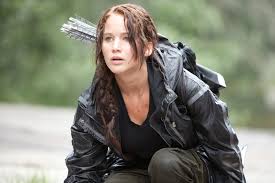
An example that show the strong female representation of the character Katniss Everdeen is this scene in the last of the trilogy, in which the protagonist is shown walking, members of her community behind her. The camerawork in this scene stands at a low angle, like Lucy, creating a sense of power. In this shot Katniss is in the centre of the screen, made the focus of the scene. This shows the importance that her character has. In this scene the camera moves backwards, tracking her character as she walks with people behind her. The effect of the people behind her moving from the side to the centre adds a sense of support and loyalty to her character as they all move to stand with her.


Furthermore, in this shot after the protagonist draws an arrow, an eye-level shot is used. This could be to show equality, perhaps presenting her as an equal to those behind her and the audience. This eye-level shot could also be used to make the audience sympathise with her character as she makes a decision, further enforcing the idea to make her appear as an equal. 


Costume is also an important aspect of her character. Through the last films she is often pictured wearing a black combat outfit, perhaps representing her strength and fury. Black often has connotations of darkness, and like Lucy, is also perhaps used to show an evil that comes with strength. 

It contrasts to her costume in the first film, in which she wears a practical grey jacket. This change to a darker and stronger use of costume could show the development of her character as she grows in power.


In contrast, Hollywood Thrillers with a superhero theme often use the idea of a classic damsel in distress, a female target for the antagonist, and someone that the male protagonist can save, proving their worth. Examples of films of this theme are Superman (1978), Spiderman (2002) and The Hulk (2003). 

These female heroins also contrast with many female characters found in film from the
1940s-1970s. Thrillers, especially film noir, would often only have a male protagonist. Films with female protagonists such as Phantom Lady (1944), Black Angel (1946), and Woman on the Run (1950), include female detectives who offer a progressive image of femininity and are ultimately proved incompetent as detectives. Furthermore, Mildred Pierce (1945), starring Joan Crawford, shows Mildred punished for being an independent and strong woman, treated with contempt, and eventually betrayed by her own daughter.


Female representation from the 1940's has reflected on society, females often portrayed as incompetent or weak without a man to guide them. However within recent cinema, protagonists are beginning to be presented as independent females, showing a developing society.  


Saturday, 31 December 2016

Camerawork in Thrillers - UPDATED


Within the Thriller genre, camerawork is important as it is a way to keep the audience attentive to what is happening onscreen, and can make them focus on certain elements within a scene. Thrillers are often intense and active, certain scenes being made to make the audience feel strong emotions such as fear and excitement, and make them feel truly involved in whats happening. 

An example of this is in Jason Bourne, a Thriller/action film. In the two first scenes of this movie clip, we are shown the protagonist making an escape. The camera angles in this scene are designed to make the audience feel the intensity and risk of what is happening. An example of this are the canted and low angle shots that are often used. Using low angle shots makes the audience aware of the significance and power of the protagonist (Jason Bourne). In this shot the camera focuses on the moterbike as it moves, which emphasises its importance in helping him escape, and also shows the power of the bike, suggesting it is equal to our main protagonist. The canted angle used in this shot and many others in this scene suggest the disorientation and fast pace of the scene, emphasising the imminent threat and our protagonists need to get away. 

Continuously throughout this scene, the camera is moving. It is often shaking side to side and wobbling as it moves to focus on each moving character. Doing this adds to the intensity and pace of the scene, making the action seem unrehearsed and disorientated, adding to the realistic effect. The camera going astray as it attempts to focus on what is happening makes the audience aware of the number of things happening, adding to the disorientation of the scene. 

Another element of camerawork within these scenes is the use of whip pan as the camera moves to focus on the incoming threat. This quick motion of the camera adds to the fast pace of the scene, making it appear more intense and keeping the audiences attention. Moving to show individual parts of what is happening within the scene also makes certain that the audience are aware of the danger for the protagonist, and know what is happening within the scene. 


Point of view shots are also used within this scene. The view of the driver in this shot shows the vehicles quick swerves and movements, emphasising the danger of what is occurring. Doing this makes the audience aware of the instability of the characters, and makes them empathise with our protagonist. This also adds to the involvement that the audience feel, emphasising the severity of the situation.

In shots focusing on our protagonist, over the shoulder shots are often used. Doing this ensures the audience see everything the character does, and also adds to the empathy the audience are led to feel for the character, as they witness everything they do and are able to feel fully involved in the scene. In this shot, an accident is almost caused as the protagonist almost crashes into the SWAT van. This quick paced moment of fear added to the use of the over the shoulder shot helps to add to the involvement the audience feel, and keeps them feeling the tension and danger of the scene.

Close-up shots are also used in this scene, focusing on our protagonist Jason Bourne. The use of these shots is to show the emotions of this character as he attempts to escape. The determination on his face shows the audience his attitude towards his situation, emphasising the bravery and purposefulness represented in this character. 


The camerawork in these scenes show the action involved within the film, and present the overall fast pace of the film. Many of the shots, such as the point of view shots, close up shots and over the shoulder shots make the audience feel involved in the action, as well as making them empathise with the protagonist. The quick cuts used, especially in the first part of the first scene, make the action appear more intense, adding to the fear and thrill felt by the audience. Overall, the camerawork in these scenes make the action seem more realistic and fast paced, and focus on making the audience feel involved in the film. 

I hope to be able to replicate this use of camerawork within my own Thriller opening, perhaps making it appear fast paced, and using shots such as close-ups and point of view shots to make the audience see a situation from one characters perspective. 

https://www.youtube.com/watch?v=9pOLr3k5Li4


Purpose of Opening Scenes in Thrillers


In any film, especially a thriller, the opening scene is very important. It needs to captivate and keep the audiences attention, raising questions and creating intrigue and mystery. It also needs to give an idea of the setting - location and time period - and make the audience have some understanding of what the plot will be.

An example of a film opening that does this is 'The Women In Black',  released 2012 and directed by James Watkins. The audience are introduced to this film by an eerie opening, in a child's bedroom. The first shots of the film shows three children sitting on the floor of the bedroom, playing with dolls and a tea set, important because later in the film we learn that dolls is a recurring theme of the film. 


In this shot, we see the three young girls, as well as their surroundings. From this, the audience are immediately introduced to the time period of the film, due to the clothes, nature of what they are playing (tea sets is often a cliche theme when young children are involved in this time period), and interior of the room. They are wearing pale dresses of pink and white, colours that connote innocence, which help to add to the sympathy and shock of the audience when they realise what will happen later in the scene. 


The very first shot is a close up of the tea cups, which immediately introduces the film location as England, as tea is a stereotypical item that is often associated with England. 

The music added to this scene immediately tells the audience that this film is not lighthearted, as the calm and slow sound gives a chilling and eerie effect, making the audience on edge, aware that something sinister is about to happen. This foreshadows the feelings of the audience throughout the film, as they are constantly on edge. 


This shot shows the three children all looking the same way at the same time, making the audience aware they are looking at something off-screen. The fact that the camera stays positioned to be focusing on the girls makes the audience question what they are looking at, adding to the eerie atmosphere, and prompting the idea of paranormal activity being involved. The music also rises in volume towards this point in the scene, making the audience aware that the atmosphere has changed, and adding emphasis on this point, suggesting to the audience that it is important and something bad may be about to happen.


The following shots show the three girls standing up and beginning to walk towards the window, crushing their seemingly beloved toys as they do so. The blank and vacant expression on their faces suggests the life has been drained from them, suggesting to the audience that they are possessed, and further enforcing the idea of paranormal activity. Doing this at the start of the film makes the audience aware of the theme of the film, and that an evil spirit may be the antagonist in the story. 


Following this, we see the girls jump from the window in unison, shocking the audience. The music continues at the same pace, continuing to suggest that this is an emotionless and vacant atmosphere, and enforcing the idea of paranormal activity. 

This opening is very effective, and instantly captures the audiences attention. The darkness of the room contrasts with the bright dresses that the children are wearing, enforcing the idea that they are surrounded by an evil atmosphere. The rule of three has also been used in this scene, as there are three children, as well as three windows. The use of three makes it more memorable to the audience, a technique often used in thrillers. Doing this ensures that the audience remember this scene throughout the rest of the film, keeping them on edge. 
The questions raised with this opening, and the intrigue of what is happening makes it evident that this is a thriller film, the tense and eerie atmosphere ensuring the audience know the nature of the film, and are constantly waiting for the next harrowing aspect. 


The Book Of Eli Opening Scene Analysis - UPDATED

The first shot of this scene shows a forest. This iconic environment is often used to create a certain type of atmosphere in a film, as they can be places full of mystery and intrigue.
The green tint of the shot paired with the non-diegetic glowing light from above creates an eerie and sinister atmosphere. The audience are instantly given the idea that the environment is threatening, the ominous and gloomy forest carrying connotations of threat and peril, putting the audience at unease. Green often has connotations of nature and is likely used in this scene because of this. However green can often create a sense of sickness and contamination, suggesting the environment is unhealthy. This gives the audience the sense of danger.


As the camera moves slowly across the ground, the first thing the audience sees is a gun. This immediately creates questions for the audience, as they are made aware that something dark and violent has potentially occurred. A gun, an iconic symbol of hatred, is often used in thrillers. This shot shows it seemingly abandoned, making the audience wonder how it got there and why.

After seeing the gun, the camera leads the audience to see a hand, and as the camera continues to move, they become aware that it is a dead body. This immediately pairs suspicion in the audience's minds, as after seeing a gun they know that this was no ordinary death. It is evident that the body has been there for a while, which further leads to the question of where this is and why it has not been found.
The hand is the first thing that the audience see of the body, and it is outstretched towards the gun. This makes the audience question whether the gun belongs to him, and further enquire who he is and why he died.

In this close-up shot, the audience are introduced to the first character. The green hue paired with the gas mask suggests the air is toxic and unbreathable. This makes the audience question where this is and gives the feel of a post-apocalyptic dystopian world. The use of masks in thriller films is iconic, as it has connotations of mystery. This makes the audience wonder who is behind the mask, and whether they are to be trusted.


An interesting part of this shot is the camera angle. The low angle shot makes the figure look bigger, suggesting his dominance and power. This makes the audience further question who he is and what authority he has. This angle can make people look unequal, as if they have a higher power, making this character seem untrustworthy, and someone to be feared.
The background of this shot is also intriguing, as the audience may wonder what is floating in the air. The ash-like substance suggests a volcanic atmosphere, further enforcing the idea that this is a toxic and unsafe environment.

In this shot, the figure is quite small and does not look as powerful as they did in previous shots. Before this, the audience are shown that they shoot a stray cat with an arrow. It is in this shot that they look down on it before picking it up. The hunched over posture and folded arms suggests guilt and shame for killing the creature. This makes the audience question their morality, and whether they killed it for sport or sustenance.
This shot adds to the sinister atmosphere of this scene, as it is evident that the figure is alone. This makes the audience further question who they are and what their purpose is.

This scene includes many components of a thriller. It creates mystery and makes the audience question what's happening and why. It is an eerie scene, which keeps the audiences attention by moving the camera slowly to show them what has happened, raising questions. The act of making the audience see a gun and then a body adds the element of surprise,  as if what they see gets steadily worse and events unfold, making them question what's going to happen next. This scene also uses iconic features of a thriller, such as guns and masks. Doing this makes the audience aware that something sinister and brutal has happened and will continue to happen. The questions raised makes the audience attentive, as they are eager to know what's going to happen next.

I will hopefully use the components within this Thriller opening when creating my own. I like the use of colour to create an atmosphere and hope to bring this within my opening, as well as the slow reveals to show the audience the sinister tone of the scene. When creating my Thriller opening I also want the audience to ask questions to add a sense of mystery and intrigue, to leave them wanting to see more and understand how the story develops.


Thursday, 22 December 2016

Independant Study - Men and Women in Film Noir - UPDATED


In Film Noir, the characterisation of men and women within film noir often reoccur.
The base of a film noir is usually developed around the idea of a male character who is cynical and hardened to the world, often a detective who is isolated and estranged from society. These types of characters often link to the general mood of bleakness and pessimism that is found in film noir, and help to establish the themes of alienation and paranoia. A common plot device within the male protagonist is amnesia, as is their ultimate downfall due to their inability to resist temptation, a self destructive urge, or being framed.
The loss of hope and unforeseeable future that also comes with the protagonist transpires from the mentality people had during the war, and reflects on the idea that much of film noir is inspired by those times.

An example of a male protagonist within film noir is Mike Hammer, a fictional private eye detective who has featured in several novels and films such as The Jury, Margin for Murder and Kiss me Deadly. His protagonist character is known as a tough and cynical man, prone to solving problems with violence, showing no mercy towards the criminals. 


In Kiss Me Deadly, Mike Hammer (played by Ralph Meeker) is portrayed as vengeful, and is said to capture the 'true essence' of the character. Mickey Spillane, the writer of the novel Kiss Me Deadly is based upon, uses Hammer as an example of consequentialism, the idea of a morally wrong act being suitable if it has a good outcome. This is shown in Hammers actions, which present him as a violent but ultimately moral character, who will stop at nothing if the goal is important enough. Mike Hammer is a good example of a protagonist used in film noir, as he is moral, but hardened to the world.

As for the women in film noir, they are mostly always portrayed as a stereotype of one of two types of characters. The femme fetale, or the Wife. 
The wife is often a character attached to a male character who has an important role within the plot, and is portrayed as dutiful, without much screen time. The use of this character is to show that the male character has a life away from the main plot, and to also present a contrast against the femme fetale. 
The femme fetale, the main female character, is portrayed as seductive and manipulative, often using her her sexuality to lead the male protagonist astray. Her power and strength when enticing and beguiling the protagonist is often represented not only through iconography such as guns and cigarettes, but also through visual style. The danger and boldness of this character is often represented through red lipstick and blonde hair, these features immediately presenting fierce beauty. 
An example of a femme fetale in film noir is Sherry Peatty in The Killing (1956), a scheming wife who uses men to kill so she can run away with her lover after performing a heist. Her character is described as bitter and promiscuous, caring for nothing but money and willing to do anything to get it. She wears red lipstick and has blonde hair, two features often found in a femme fetale, and is a classic example of this character, as she is unforgiving and cunning in her intentions. 

In film noir these classic character types can often be found, and have become iconic in the world of noir.  Men are often portrayed as strong but ultimately weak when faced with a threat, and often are victims in a cruel and unforgiving setting. The female character are mostly portrayed as cunning, dangerous and cruel to men, often made that way after being treated as a prize to be won. Over the years many films have taken inspiration from these character types, and they are often found throughout many genres.

The historical context behind these gender roles, especially the role of the femme fetale, could lie behind the beginning of efforts for a legal declaration for women to be equal to men. As women moved further into the public sphere and community, they gained a degree of respect and power, especially after opportunities for women to have jobs. This was an opportunity gained after the war, as women worked in factories while the men fought, gaining respect as they looked after the community without their husbands. This relates to much of film noir as the war did heavily inspire many of these films, and perhaps is the reason women are portrayed as powerful and deadly. 


Motifs: The Great Gatsby - UPDATED


A motif is a recurring element of symbolic significance within a story. 


The Great Gatsby was first a 1925 novel set in the summer of 1922, written by F. Scott Fitzgerald, an American author. It was created as a film in 1974, and again recently in 2013.


In the time that it is set, the likely aspiration of an American dream would be success and fortune, however Gatsby has already achieved this, so his dream focuses on a woman. Although Fitzgerald does not mention the idea of the American dream in the novel, he still shows the impossibility of achieving a desire for happiness through symbols and motifs, which are continued in the film.
The story focuses on the character Jay Gatsby and the woman he is in love with, Daisy Buchanan, and is a prime example in the use of motifs. 
An element of symbolic significance in The Great Gatsby is the green light that Gatsby sees at the end of Daisy's dock. To Gatsby, this green light represents his American dream, which is Daisy. The light is described as 'minute and far away', suggesting that it is impossible to reach, emphasising the idea that is is an unattainable goal in Gatsby's life. 
The green light also represents the future, suggested when the novel reads 'Gatsby believed in the green light, the future that year by year recedes before us'. The light is elusive and uncertain, much like Gatsby's future, emphasising the idea that his dream is hopeless even if he is determined. The light is also never constant, continually fading, maintaining the idea that the future is not settled and decided.
In the film the light is shown in different forms, each representing the never-ending love Gatsby has for Daisy. When the seemingly unreachable light appears closer, it demonstrates how emotionally close Gatsby may be to Daisy. This is shown when the light is intense and bright, suggesting Gatsby is further to his goal, and more capable of achieving his dream of Daisy being his. The intensity of the light could also suggest that his love for her is undying, as he refuses to give up on his dream, unwavering from his love for her. 
The fact the light is green is also important when considering its symbolic significance. 
Green is a colour associated with spring, which symbolises growth, and confidence. This emphasises the severity of Gatsby’s love for Daisy, and the determination in which he seeks to achieve his dream.

In this over the shoulder shot, the audience can see that Gatsby is reaching out towards the light. This suggests that he feels the closeness of it, and believes his dream is within reach. An alternative idea to this shot is that he has become desperate to achieve his goal, yearning for his dream, possibly knowing this is as close as he could get. The positioning of this shot makes the audience sympathise with him, aware of his determination and empathising with his willingness not to give up on his dream.
When his dream of being with Daisy falls apart, the symbol of the green light changes. Instead of representing his hope and willpower, it represents his misfortune, a reminder of his loneliness and the truth of his reality. Further, this also represents the ultimate failure of the American dream, demonstrating how dreams are often unreachable.

For my Thriller opening I hope to also use a motif that can continue throughout the idea of the film. An idea for a motif I am interested in is the use of shadows - or one particular reoccurring shadow - to create a concept or idea, perhaps of the unknown and secrecy. 
I like the idea of using a motif as I believe it can tie together an idea, making a concept involved within a film but without it being too explicit. Because of this, I hope to be able to use a motif within my own work. 


Tuesday, 20 December 2016

Sound in Thrillers


Sound is an important element of any film, especially thrillers. This is because it can add to the pace, emotion and anticipation of any scene, and make the audience react in different ways according to what is happening.
An example of sound in a thriller being used effectively is in Psycho (1960), a slasher/thriller. An iconic scene from this film is the shower scene, a murder scene in which a female character meets her end due to a serial killer.


The beginning of this scene has slow non-diegetic sound that rises in volume as she enters the bathroom. This creates tension, making the audience aware that there is something sinister about to occur. This sound then stops, and the only thing heard are the diegetic sounds of  the characters footsteps, and the sounds around her such as the shower curtain and water. The lack of underscore in this part of the scene makes the audience feel on edge as there is nothing to set the tone of the scene. This uncertainty makes the ending of this scene more alarming, as the audience do not know what to expect when there is nothing added to give an atmosphere. 


When the door opens, unseen by the character, still the only sound to be heard is the water. This creates uncertainty, as the audience are aware of the threat but unsure of what it means without music accompanying it. The non-diegetic sound only begins again once the shower curtain is ripped to the side, revealing the silhouette of the murderer. The high pitched and loud music accompanied by her scream immediately establishes fear, making the audience aware of the danger, and emphasising the panic and shock felt by the character. This high pitched sound continues as she is murdered, rising in volume and pace. The effect of this is to show that the peril of the scene is only being intensified, implying there is no escape and that she has met her end. 


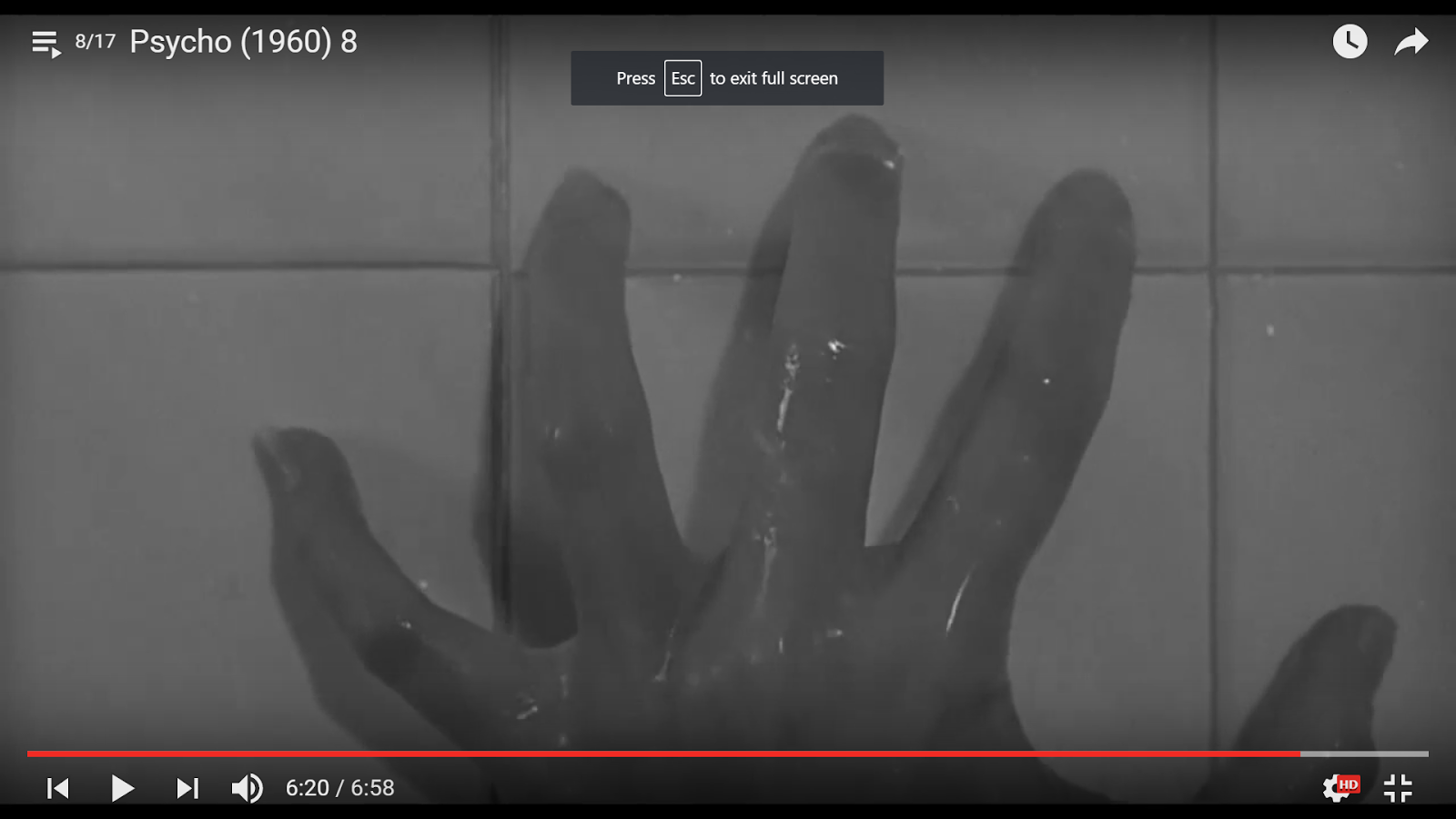
As the murderer leaves, the pace of the music is slower, and with a lower pitch. This paired with the close-up of the characters hand slowly going down the wall shows that although the danger has gone, she has become weak. The heavy repetitive thud of this slow paced sound could resemble the ticking of a clock, perhaps suggesting that her time is running out. 
The music then continues to fade away, and the audience are left again with the diegetic sound of the running water, the simplistic sound creating a contrast against the horror of what has happened, and emphasising the harshness of the sound before. 

Directed by Hitchcock, Psycho, along with many of his other films, focus of the visual aspect of a scene. However the sound used in his films is known to have mass effect on an audience, manipulating their emotions, particularly in this well known scene in which the sound has become iconic in its use, as its pace and pitch alarm the audience, inciting fear.